The free register that tells your energy and water companies you may need extra help
The Priority Services Register is a free list kept by energy suppliers, the companies that run the local power and gas networks, and water companies. Being on it changes how they deal with you, from warnings about planned power cuts to a password for anyone who knocks at the door.

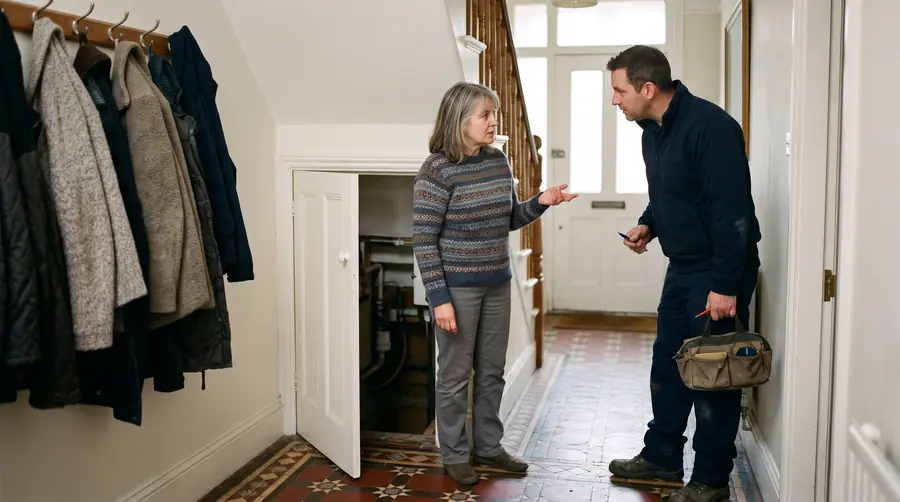
Most people only discover the Priority Services Register when a neighbour mentions that the electricity network phoned ahead before a planned power cut, or that the man who came to read the meter had to give a password first. It sounds like a special arrangement. In fact it is a standard service that energy and water companies are required to offer, and joining costs nothing.
The register exists because the same event can be a minor inconvenience in one home and a real problem in another. A four-hour power cut is one thing for a family with a gas hob and torches, and quite another for someone who relies on an electric bed, a stairlift or a fridge full of medicine.
What the register is
The Priority Services Register, usually shortened to PSR, is a record of customers who may need extra help or different ways of communicating. Ofgem requires energy suppliers and network operators to keep one. Water companies in England and Wales keep their own, overseen by the water regulator Ofwat. Being on a register does not change your tariff or your bill. It changes how the company treats you when something goes wrong or when it needs to contact you.
Who keeps a register, and why there are several
Many people are surprised to learn there is not one single list. Your energy supplier, the company you pay, is different from your network operator, the company that owns the cables and pipes and deals with power cuts. Each keeps its own register.
| Organisation | What it does for you | How to reach it |
|---|---|---|
| Energy supplier (gas and electricity) | Billing, meter readings, accessible bills, passwords for visits | Contact details on your bill |
| Electricity network operator | Power cuts: advance notice of planned work, priority support in emergencies | Call 105 in a power cut, or apply online at thepsr.co.uk |
| Gas network operator | Gas emergencies and reconnection | Usually passed on by the electricity network with your consent |
| Water company | Supply interruptions, bottled water deliveries, accessible bills | Contact your water company directly |
If your gas and electricity come from different suppliers, Ofgem advises contacting each of them. When you switch supplier, ask the new one to add you, because registrations do not always travel with you.
Who can join
Ofgem lists a broad range of circumstances. You can ask to join if you:
- are of State Pension age;
- are pregnant or have young children (Citizens Advice mentions children under five);
- have a disability or a long-term medical condition, including mental health conditions and conditions affecting sight, hearing or sense of smell;
- use medical equipment that needs a power supply;
- struggle to speak or read English;
- are going through a temporary change, such as recovering from an operation or a hospital stay, a bereavement or the loss of a job.
Citizens Advice adds people who cannot smell gas, who find it hard to get to the door, or who are returning home from residential care. You do not need to prove a diagnosis to ask, and temporary needs can be added for a set period.
What being on it can mean
The services vary a little between companies, but Ofgem lists the core ones:
- advance notice of planned power cuts, wherever possible;
- priority support in an emergency, which Citizens Advice says can include welfare checks and hot meals during long outages;
- a password scheme, so anyone calling or visiting on behalf of the company can prove who they are;
- nominating a relative or friend to receive letters and bills as well as, or instead of, you;
- bills in large print or braille;
- regular meter readings if you cannot read the meter yourself;
- moving a prepayment meter you cannot reach safely;
- help to reconnect your gas supply after an interruption.
Water companies offer similar help, including bottled water deliveries during an interruption for customers who cannot collect it.
An example household
 Illustrative example
Margaret, 71, lives alone in a bungalow and uses an electric riser chair. Her son lives 40 miles away. These people are invented to show how the register works in practice.
A general illustration. Services and processes vary between companies.
How to join, and keeping it up to date
There are two simple routes. You can ask your energy supplier using the contact details on your bill, or apply to your electricity network operator, which you can do through the central website thepsr.co.uk. Citizens Advice explains that, with your consent, the network operator passes your details on to your gas network and your suppliers. If you hear nothing within two weeks, it is worth chasing.
- Have your address, account numbers and a short description of your needs to hand.
- Contact your supplier or your electricity network operator and ask to join.
- Ask whether they will share the details with the other energy companies.
- Contact your water company separately unless it confirms it already has your registration.
- Set up a password and, if useful, a nominee.
In some areas energy and water companies have begun sharing registrations with customers’ consent, but this is not universal, so registering with your water company directly is the safest course. When you move home you need to register again at the new address, and needs that change should be updated.
 In a power cut
105 is the free number for reporting or asking about a power cut in England, Scotland and Wales. It connects you to your local network operator, whichever supplier you pay.
Who this matters for, and what to check
The register is most useful for households where an outage or a doorstep caller could cause real difficulty: people living alone, people with medical equipment, families with a newborn and anyone recovering from illness. It is also worth considering for an older parent who lives some distance away, with their agreement.
- Ask each company you deal with whether you are already on its register. Many people are on one list but not the others.
- Check the password arrangement works, and keep the password somewhere sensible.
- If you have recently had a smart meter fitted, mention any medical equipment so installation can be planned around it.
- If a household member has died, update the register as part of the wider paperwork covered in our guide to joint accounts after a death.
The Priority Services Register is free and changes how energy and water companies look after you rather than what you pay. Join through your supplier or network operator, register with your water company as well, and update it when you move or your needs change.
Official sources
- Ofgem: Join your supplier’s Priority Services Register: who can join and the services offered
- Citizens Advice: Getting extra support from your energy supplier: joining via the network operator, extra eligibility groups
- The Priority Services Register (electricity network operators): online application
- Ofwat: regulator of water companies in England and Wales
ISI Seal is an independent, sponsored information site published by Sapienter OÜ. It is a private website, not a government website, and is not affiliated with HM Revenue & Customs, the Department for Work and Pensions, the NHS or any regulator, pension scheme, bank, energy company or insurer. This article is general information, not personal financial, legal or tax advice. Every amount is either a published official figure with its date or a clearly labelled illustration; none of them is a promise or an estimate of your own position. The facts were checked on 2 November 2026 and can change. This site processes no applications, makes no decisions and charges no fees. Never give your National Insurance number, bank details, PINs or Government Gateway or GOV.UK One Login details to a website you reached from an article. For your own case, use the official services on GOV.UK or contact the organisation concerned directly.

The Saturday Letter
Every Saturday morning, one household-money rule explained plainly, from pensions and tax to energy bills and family paperwork, with a link to the official source. Free.
 More to read