Who gets a free NHS eye test, and what an optical voucher pays towards
Everyone aged 60 or over in England can have a free NHS sight test, but turning 60 does not by itself bring help with the cost of glasses. A free test and an optical voucher are two separate things with different rules, and knowing which applies saves an awkward moment at the counter.
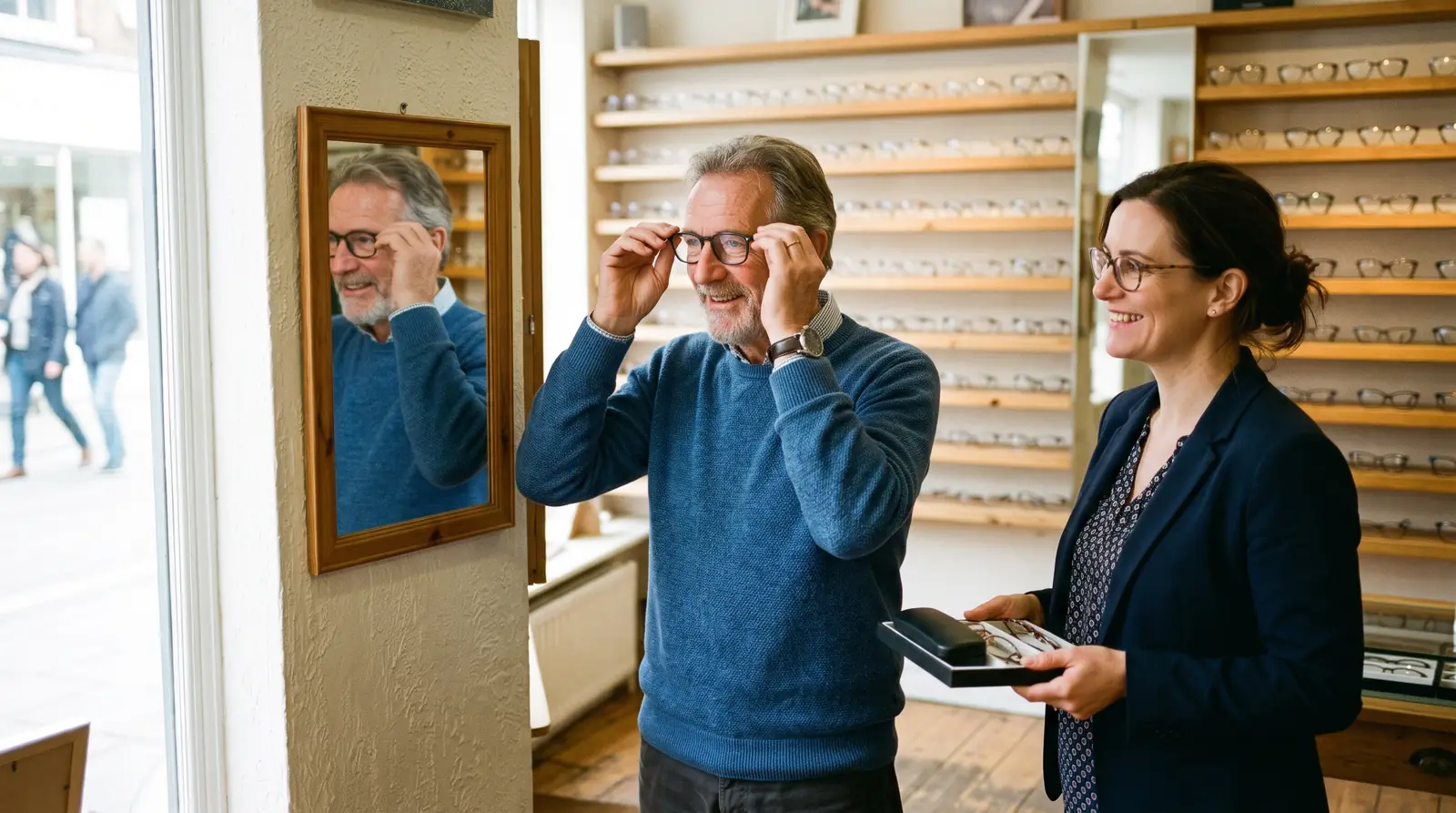
Many people book an eye test around their sixtieth birthday because they have heard it becomes free, and they are right. What can come as a surprise is the next step. The optician recommends new glasses, the frames are chosen, and the bill is the same as it was at 59.
That is because the NHS treats the sight test and the cost of glasses separately. One is free for a broad group of people. The other, the optical voucher, is aimed at children, people with complex prescriptions and households on low incomes.
Two separate entitlements
An NHS sight test checks your vision and the health of your eyes. Optometrists can pick up signs of conditions such as glaucoma, cataracts and diabetes-related eye disease, which is part of why regular tests are recommended as people get older.
An optical voucher is a fixed contribution towards the cost of glasses or contact lenses. It does not depend on age over 60, and qualifying for a free test does not automatically mean you qualify for a voucher.
Who gets a free NHS sight test in England
The NHS website lists who can have a free sight test. You qualify if you:
- are 60 or over;
- are under 16, or 16 to 18 and in full-time education;
- are registered as sight impaired or severely sight impaired;
- have been diagnosed with diabetes or glaucoma;
- are 40 or over and your parent, brother, sister or child has glaucoma;
- have been told by an eye doctor that you are at risk of glaucoma;
- are eligible for a complex lens voucher;
- hold a valid HC2 certificate under the NHS Low Income Scheme;
- receive, or your partner receives, certain benefits, including Pension Credit Guarantee Credit, income-based Jobseeker’s Allowance, or Universal Credit where the criteria are met.
Who gets an optical voucher
The NHS website is explicit that being 60 or over does not on its own entitle you to a voucher. You may get one if you:
- are under 16, or 16 to 18 and in full-time education;
- have a complex prescription, for which complex lens vouchers exist;
- hold a valid HC2 certificate;
- receive, or your partner receives, the qualifying benefits listed above.
People with an HC3 certificate, which gives partial help under the Low Income Scheme, may get help towards the cost. To apply to the scheme you complete form HC1; the result is an HC2 for full help or an HC3 for partial help, depending on income and savings.
How a voucher works in practice
Vouchers are banded by the type and strength of lens, from single-vision lenses through bifocals to more complex prescriptions. Each band has a fixed value set nationally. The optician gives you the voucher after the test, and you can use it at any optician that accepts NHS vouchers.
If you choose glasses that cost the same as the voucher, or less, you pay nothing. If you choose more expensive frames or extra lens treatments, the voucher is deducted and you pay the difference. The NHS website lists the value of each band; for example, it shows voucher A, the lowest single-vision band, at £42.40. Values are reviewed from time to time, so ask the optician to confirm the current amount.
Three example patients
| Patient | Free sight test? | Optical voucher? |
|---|---|---|
| Graham, 62, working, no qualifying benefits | Yes, aged 60 or over | No |
| Susan, 55, diagnosed with type 2 diabetes | Yes, diabetes | No, unless she qualifies another way |
| Brenda, 68, receives Pension Credit Guarantee Credit | Yes | Yes |
Graham and Susan both get a free check of their eye health, which is the main purpose of the test. Brenda also gets a fixed contribution towards her glasses.
How often, and tests at home
The NHS says a free sight test is usually available every two years, or more often if your optometrist recommends it, for example because of a medical condition or a change in your vision. You do not have to wait for symptoms.
If you qualify for a free sight test but cannot leave home without help because of illness or disability, you may be able to have an NHS test at home. Mobile tests are also offered in care homes and day centres. Ask a local optician which providers cover your area.
 When you book
Tell the practice which category you qualify under, and take proof if it applies, such as an HC2 certificate or a benefit award letter. You will usually be asked to sign a form confirming your eligibility.
Scotland, Wales and Northern Ireland
Eye care is a devolved matter, so the rules differ. In Scotland NHS eye examinations are free for everyone. In Northern Ireland, nidirect explains that free sight tests and vouchers are available to people entitled by age, a medical condition or certain benefits, with an HC1 application leading to an HC2 or HC3 certificate valid for 12 months. Wales has its own NHS eye care arrangements. If you live outside England, check the official health service website for your nation.
Who this matters for, and what to check
- Anyone turning 60 in England who has not had a recent test: the test itself is free.
- People on a low income who do not receive qualifying benefits: an HC1 application may lead to help with glasses as well as other health costs.
- Families with a history of glaucoma: the free test can start from 40.
- Anyone caring for a relative who finds it hard to get out: ask about home visits.
Health costs are one part of household planning in later life. Our guides to free pension guidance and the Priority Services Register cover two other free services worth knowing.
In England, a free NHS sight test comes with turning 60, a diagnosis such as diabetes or glaucoma, or certain benefits. An optical voucher towards glasses is narrower: it depends on income, benefits, age under 19 or a complex prescription, not on being over 60.
Official sources
- NHS: Free NHS eye tests and optical vouchers: who qualifies for each
- NHS: How often can I have a free NHS eye test?: every two years or as recommended
- NHS: Voucher values for glasses and lenses: value of each voucher band
- nidirect: Help with health costs: Northern Ireland arrangements
ISI Seal is an independent, sponsored information site published by Sapienter OÜ. It is a private website, not a government website, and is not affiliated with HM Revenue & Customs, the Department for Work and Pensions, the NHS or any regulator, pension scheme, bank, energy company or insurer. This article is general information, not personal financial, legal or tax advice. Every amount is either a published official figure with its date or a clearly labelled illustration; none of them is a promise or an estimate of your own position. The facts were checked on 2 November 2026 and can change. This site processes no applications, makes no decisions and charges no fees. Never give your National Insurance number, bank details, PINs or Government Gateway or GOV.UK One Login details to a website you reached from an article. For your own case, use the official services on GOV.UK or contact the organisation concerned directly.

The Saturday Letter
Every Saturday morning, one household-money rule explained plainly, from pensions and tax to energy bills and family paperwork, with a link to the official source. Free.
 More to read