What changes when a smart meter is fitted, and what stays exactly the same
A smart meter reads itself and comes with a small display for the kitchen. It does not change your tariff, lower your bill on its own or tie you to your supplier. What to expect on the day, and the settings worth knowing about afterwards.
The letter or email usually arrives without much fanfare: your energy supplier would like to book a smart meter installation. For many households the visit is over in a couple of hours. For others the questions start afterwards. Why is there a little screen on the worktop? Is the supplier now watching every kettle? Will the bill go down?
A smart meter is a fairly modest piece of kit. It measures the same electricity and gas as the meter it replaces, but sends the readings to your supplier by itself. Most of what people worry about, and hope for, depends on settings around the meter rather than the meter itself.
By the end of June 2026 there were 42 million smart and advanced meters in homes and small businesses in Great Britain, according to the government’s quarterly statistics. That is 72% of all meters, so a smart meter is now the normal case rather than the exception.
What happens on the day
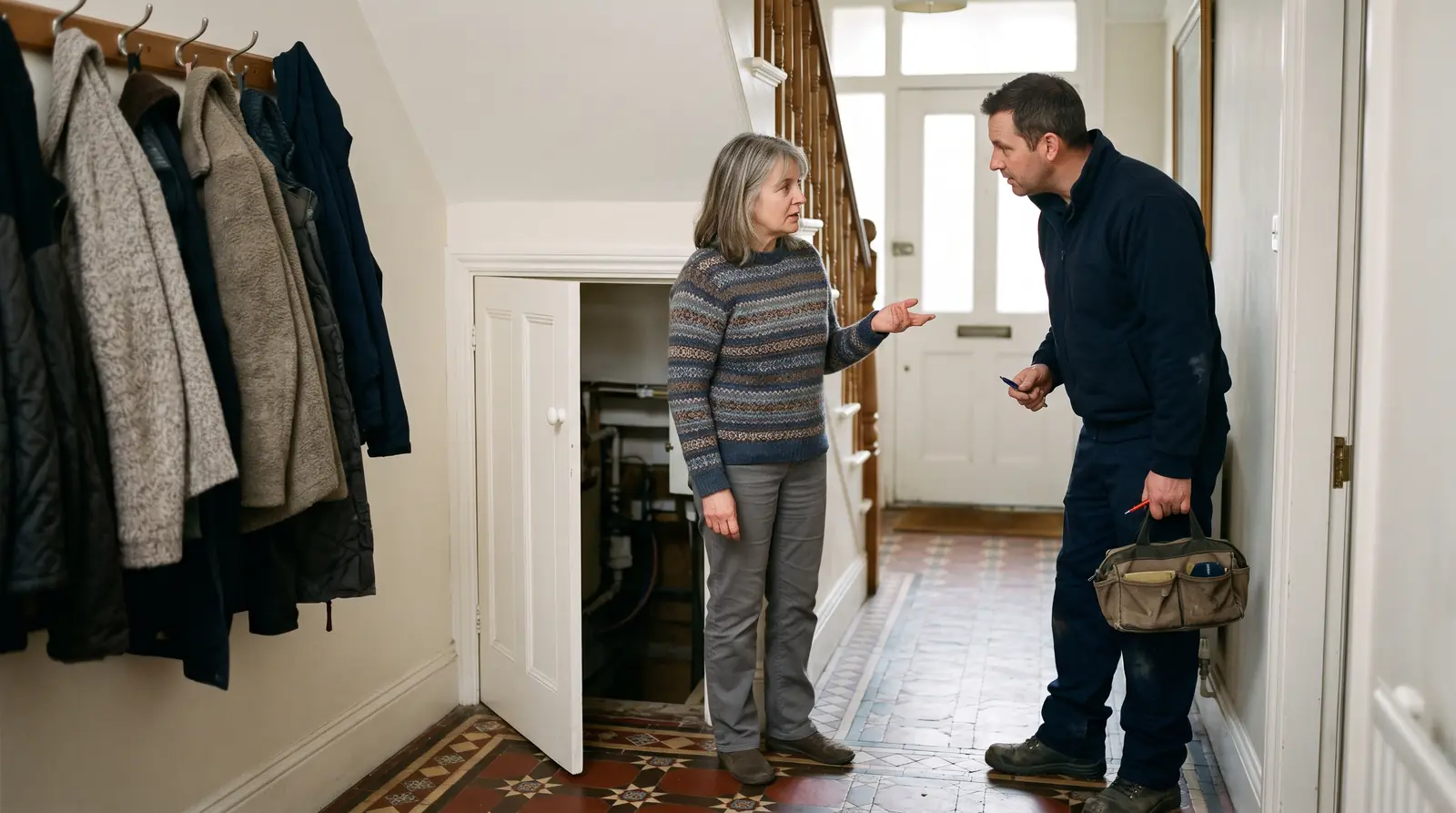
Suppliers are obliged to offer every household in Britain a smart meter at no extra cost. You do not pay anything on the day; as with ordinary meters, the cost of the programme is spread across everyone’s bills. An installer swaps the old electricity meter and, if you have mains gas, the gas meter as well. The supply is off briefly during the work, so mention anything that needs constant power when you book.
The installer usually leaves an in-home display, a small unit showing how much energy you are using. It is not needed for the meter to work.
What actually changes
The table sets out the practical differences. It is a general comparison, not a description of any particular supplier.
| Everyday task | Traditional meter | Smart meter in smart mode |
|---|---|---|
| Meter readings | You send them, or the supplier estimates | Sent automatically |
| Bills | Often based partly on estimates | Based on actual readings |
| Seeing your use | Read the dials yourself | In-home display shows use through the day |
| Tariff and unit price | Set by your tariff | Unchanged: still set by your tariff |
| Time-of-use tariffs | Generally not available | Available if half-hourly data is shared |
| Bill size | Depends on how much you use | Still depends on how much you use |
The biggest everyday difference is the end of estimated bills, which usually settles an account that has drifted into credit or debit.
What stays the same
Citizens Advice is plain about the point most people want answered: a smart meter will not automatically save you money. The unit rate and standing charge are set by your tariff, and the meter simply records what you use. Some households use less once they can watch the display, but that saving comes from behaviour, not from the meter.
Nothing about your contract changes either: same tariff, same supplier, same rules on billing and complaints. You also do not have to accept a smart meter at all. Refusing can make it harder to get some tariffs, and you can instead ask for a smart meter with its smart functions switched off, so that it sends nothing to your supplier. Check first that your supplier can do this.
How often readings are sent
This is the setting that surprises people most. According to Citizens Advice, meters installed since 3 November 2022 send electricity readings every half hour by default and gas readings once a month. You can ask for electricity to be sent daily instead, and gas can be changed to daily or half-hourly, through your online account or by calling your supplier.
Half-hourly data matters because the industry is moving to market-wide half-hourly settlement, which Ofgem expects to be complete by 7 May 2027. Newer time-of-use tariffs, which charge less at quieter times, are only available to smart meter customers who share half-hourly data.
Switching supplier with a smart meter
A smart meter does not tie you to the company that fitted it. Second-generation meters, known as SMETS2, keep their full smart functions when you switch. Older first-generation SMETS1 meters may lose some smart features for a while after a switch but still measure accurately, and they are being moved remotely onto the national smart network run by the Data Communications Company. Either way, you do not need a new meter to change supplier or tariff.
Some homes will need an upgrade as the 2G and 3G networks close, with full switch-off expected by 2033. Smart Energy GB says most only need the communications hub replaced, free of charge.
Prepayment mode and the rules around it
A smart meter can run in prepayment mode, where you top up in advance, and it can be switched into that mode remotely. Since 8 November 2023 Ofgem’s rules on involuntary prepayment have been enforceable licence conditions. Before a supplier moves a customer to prepayment against their wishes, it must make at least 10 attempts to contact them and carry out a welfare visit. Involuntary prepayment should not be used in homes where everyone is 75 or over with no other support, where there are children under two, where someone needs a continuous supply for health reasons, or where nobody can top up.
Choosing prepayment yourself is a different matter: some households like the control it gives.
 Worth knowing
If someone in your home depends on electrically powered medical equipment, or would find a power cut hard to manage, the free Priority Services Register lets your supplier and network operator know before any planned work.
When a smart meter stops being smart
Government figures show that 92% of the 40 million smart meters in Britain were working in smart mode in June 2026, which leaves a minority sending nothing. You often notice because bills go back to estimates or the display goes blank. Citizens Advice suggests asking your supplier whether smart mode is on, since it can often be restored remotely, and sending your own readings each month in the meantime.
- Report the fault to your supplier and note the date.
- Since 23 February 2026 the supplier must make an initial assessment of a reported fault within five working days, with compensation if it does not.
- Keep giving your own readings so that bills stay accurate.
- If the problem drags on, complain to the supplier and, after eight weeks or a final response, to the Energy Ombudsman.
Who this matters for, and what to check
- Anyone offered an installation who wants to know what they are agreeing to.
- Households unsure how often their meter sends readings: your online account or supplier will tell you.
- People thinking about a time-of-use tariff, who will need to share half-hourly data.
- Anyone whose bills have gone back to estimates. That is a sign the meter is not working in smart mode.
Our piece on home insurance renewals looks at the other household bill tied to your address, and our guide to the paperwork after a death covers telling utilities as well as government.
A smart meter swaps manual readings for automatic ones and gives you a display to watch. Your tariff, your supplier and the size of your bill stay in your hands. The settings worth checking are how often readings are sent and whether the meter is still working in smart mode.
Official sources
- Citizens Advice: Getting a smart meter installed: cost, refusing a meter, how often readings are sent
- Ofgem: Getting a smart meter: in-home display and what the meter does
- GOV.UK: Smart meters in Great Britain, quarterly update June 2026: 42 million meters, 72% of all meters, 92% in smart mode
- Ofgem: New prepayment meter rules: involuntary prepayment protections from November 2023
ISI Seal is an independent, sponsored information site published by Sapienter OÜ. It is a private website, not a government website, and is not affiliated with HM Revenue & Customs, the Department for Work and Pensions, the NHS or any regulator, pension scheme, bank, energy company or insurer. This article is general information, not personal financial, legal or tax advice. Every amount is either a published official figure with its date or a clearly labelled illustration; none of them is a promise or an estimate of your own position. The facts were checked on 2 November 2026 and can change. This site processes no applications, makes no decisions and charges no fees. Never give your National Insurance number, bank details, PINs or Government Gateway or GOV.UK One Login details to a website you reached from an article. For your own case, use the official services on GOV.UK or contact the organisation concerned directly.

The Saturday Letter
Every Saturday morning, one household-money rule explained plainly, from pensions and tax to energy bills and family paperwork, with a link to the official source. Free.
 More to read